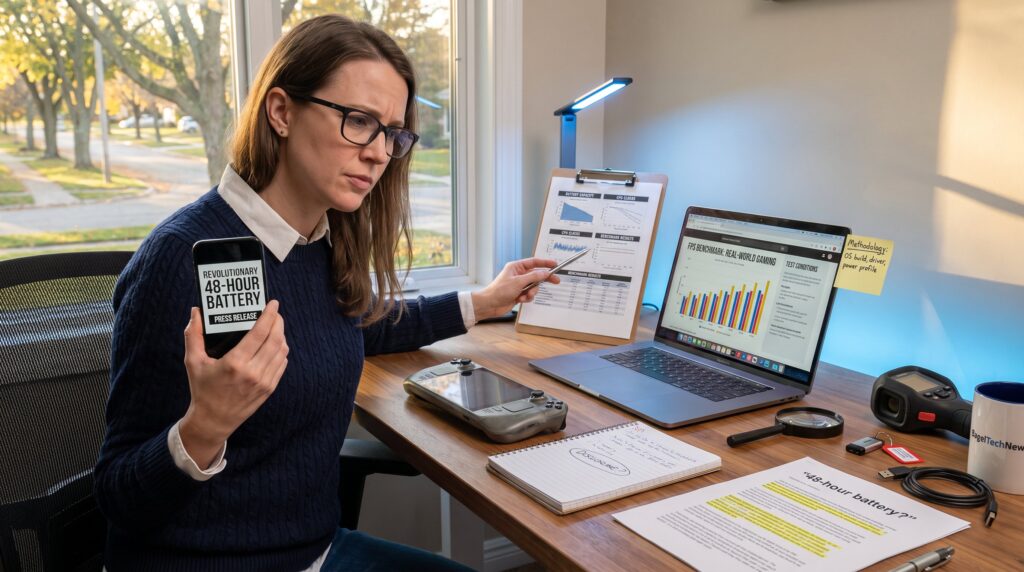
Ways to Evaluate Product and Gadget Claims in Tech News starts with a simple truth: not every headline equals verified performance. Readers and reporters must treat product announcements as testable claims, not final judgments. This guide gives concise checks, testing habits, and red flags that help distinguish honest reporting from marketing spin. It uses practical steps reporters can follow and readers can replicate, from quick verification to digging into sponsorships, so they can decide which gadget claims are credible and which deserve skepticism.
Key Takeaways
- Evaluate product and gadget claims critically by verifying core specifications against manufacturer datasheets and independent reviews.
- Prefer reviews that transparently disclose test conditions, methodologies, and potential conflicts of interest to ensure credibility.
- Look for reproducible tests and multiple independent sources that converge on similar findings to confirm performance claims.
- Be cautious of marketing language and vague superlatives; demand quantifiable data and contextual evidence for advertised features.
- Always check for sponsorship disclosures and editorial transparency to identify possible biases in product reporting.
- Apply a systematic checklist approach to distinguish honest reporting from marketing spin and make informed decisions on tech gadgets.
Quick Verification Checklist For Readers And Reporters
Start with the decisive action: verify the core claim before sharing it. A quick checklist saves time and prevents repeating hype.
- Compare the headline claim to the manufacturer’s published datasheet and at least two independent reviews. If a phone claims “48-hour battery,” confirm the battery capacity and test conditions.
- Look for explicit disclosures in the article: was the unit provided for free, were affiliate links used, or was travel paid? Transparent pieces state this up front.
- Seek concrete usage details: follow-up impressions after weeks, sample photos or videos from real use, and logs like screen-on-time or frame-rate charts.
- Check for trade-offs: robust reporting lists negative points (heat, throttling, shortcuts) as well as benefits.
Practical example: a reviewer who wrote that a handheld console “lasted a weekend” later admitted they tested only light indie games. That admission changed how readers judged battery claims. Reporters should adopt that same candor.
Links to relevant site resources: readers who want context about BagelTechNews’s coverage approach can read a short overview at site guide to see how editorial standards apply across reviews. For broader context on how BagelTechNews reports breaking stories, consult the inside review hub and a roundup of what the headlines mean in daily practice on their must-read headlines page.
Verify Specs, Benchmarks And Real-World Performance
Fact first: marketing specs are claims that require reproducible tests. Treat every spec as a hypothesis.
When a company posts numbers, CPU clocks, sensor megapixels, or battery cycles, the reviewer should reproduce those conditions or clearly explain why they differ. A graphics benchmark that lists average FPS must include GPU model, driver version, OS build, and power profile. Without that, numbers are almost meaningless.
Reporters should prefer tests that explain methodology and baseline comparisons. For example, a laptop review that compares battery life against two specific competing models (naming model, display brightness, and workload) gives readers actionable insight. Readers should ask: does this benchmark measure what I care about? Synthetic tests that push hardware to extremes may not reflect everyday use: conversely, casual browsing tests understate gaming behavior.
A common mistake: running a single benchmark and declaring victory. A more reliable approach runs multiple workloads (office, streaming, gaming), logs temperatures, and repeats tests after a week of normal use to catch thermal throttling. That process revealed a 15% performance drop after 72 hours in one handheld review, a crucial trade-off readers deserved to know.
BagelTechNews readers can find related product analysis on the site’s smart coverage guide, which outlines standards for reproducible testing and real-world evaluation.
Trusted Sources, Test Conditions, And Reproducibility
Clear takeaway: trust reviews that publish test protocols. Transparency in method beats flashy results.
Trusted outlets publish detailed test setups: exact hardware, software versions, test scripts, and environmental conditions. That lets other reviewers reproduce results. If a reviewer does not state the test OS build or uses a custom power plan without disclosure, readers should treat the numbers cautiously.
Reproducibility also means multiple independent reviews converge on similar findings. If five independent labs report comparable battery degradation after 500 cycles, the claim gains credibility. Conversely, when only the manufacturer or a sponsored review shows a dramatic advantage, skepticism is warranted.
Practical check: look for downloadable logs, video captures, or open test scripts. Those artifacts let curious readers rerun workloads or spot selective reporting. BagelTechNews’s product pages often link to hands-on test notes for deeper inspection: for tips on navigating those sections, see the how to navigate posts. Another useful resource shows where to find social coverage across the site at where to browse.
Vulnerable moment: a reviewer once misreported USB throughput because they used a faulty cable. They published a correction and reran tests: that honesty improved reader trust more than the original headline ever did.
Assess Manufacturer Transparency, Marketing Language, And Claims
Key point: marketing uses persuasive language, not scientific precision. Spot slogans and treat them as marketing, not fact.
Manufacturers frame claims to sell, “industry-leading,” “breakthrough,” and “unmatched” often lack measurable definitions. Reporters should probe for quantifiable thresholds: what does “industry-leading” mean here, by what metric, and against which competitors?
Readers can flag copy-and-paste phrases that appear unchanged across press materials and multiple news sites: identical language often signals a press release has become the article. Good coverage rewrites those lines, tests claims, and calls out missing evidence.
Examine limitations: are caveats listed? If a camera sensor boasts better low-light performance, does the report show sample images at matching ISOs and shutter speeds? If not, the claim lacks context.
A practical measure: ask for raw data or side-by-side comparisons in identical settings. When a smart home device claims “99% accuracy,” ask which dataset produced that figure and whether edge cases were tested.
BagelTechNews’s coverage of ecommerce product configurators shows how product descriptions can diverge from delivered experience: see their analysis on product configurator trends for a concrete example of claims vs. outcomes.
How To Spot Conflicts Of Interest And Sponsored Coverage
Essential fact: financial ties change incentives. Identify and weigh them.
Conflicts include free review units, sponsored trips, affiliate links, equity, or paid research. Transparent outlets list these relationships. If an article omits disclosures, readers should be wary. Sponsored content should be clearly labeled: undisclosed perks are a major red flag.
Look for subtle signals: unusually promotional tone, lack of trade-off discussion, or unusually fast publication after a product launch can indicate brand influence. Check the author’s recent pieces, repeated coverage of the same vendor with similar praise may point to ongoing partnerships.
Practical test: search for affiliate disclosures or an editorial ethics page. BagelTechNews publishes guidance on editorial independence across its site, which helps readers understand how reviews are produced and edited. For context on who the site serves, the page about who it is for explains audience expectations and standards.
A warning: sponsored reviews can still be useful if they disclose limits and show raw test data. The problem is undisclosed influence. When in doubt, favor outlets that publish corrections and let readers inspect test logs.
Conclusion
Actionable insight: treat every claim as testable and every review as a combination of data, method, and incentives. Readers who apply the checklist, demand reproducible tests, and watch for sponsorship signals will make better decisions. BagelTechNews aims to publish work that meets these standards: readers who practice these checks will spot truth amid launch-day hype.