A few years ago, “visibility” meant one thing: where you sat on a results page.
Not anymore.
Millions of searches now end inside a chat window instead of a browser tab. Someone asks ChatGPT for the best HVAC company in their zip code, and if your business isn’t part of the answer, you’ve lost that customer before your website ever loads. No click. No bounce rate. No trace in Google Analytics. Just a conversation that happened somewhere you couldn’t see, about a decision you had no say in.
That’s the world AI brand mentions live in, and it’s why more marketers are treating them as seriously as rankings and backlinks.
What Are AI Brand Mentions?
An AI brand mention is any instance where a generative engine, think ChatGPT, Gemini, Claude, Perplexity, or Grok, names your business in a generated answer. Sometimes it comes with a clickable citation. Often it doesn’t. Either way, the model just told a real person that your brand exists, and possibly that it’s the best option for what they need.
That last part matters. A mention isn’t neutral. The engine is making a judgment call about relevance and trust, based on training data and whatever it retrieves live from the web while answering.
Why AI Brand Mentions Matter More Than Rankings Alone
Ranking #1 for a keyword used to be the finish line. Now it’s closer to the starting line, because a growing share of users never reach the page you ranked for.
The Zero-Click Shift
Generative engines compress the research phase. Instead of opening five tabs and comparing options, a user asks one question and gets a synthesized answer. If your business isn’t part of that synthesis, the fact that you technically rank first in organic search becomes almost academic.
Mentions Build Trust Signals Even Without a Click
Search engines and AI systems both seem to weigh how consistently a brand shows up across the web, not just whether it’s linked. Repeated, consistent mentions across trustworthy sources function as a kind of ambient credibility. It’s slower to build than a single backlink, but it tends to be harder for a competitor to fake.
How AI Engines Decide Which Brands to Mention
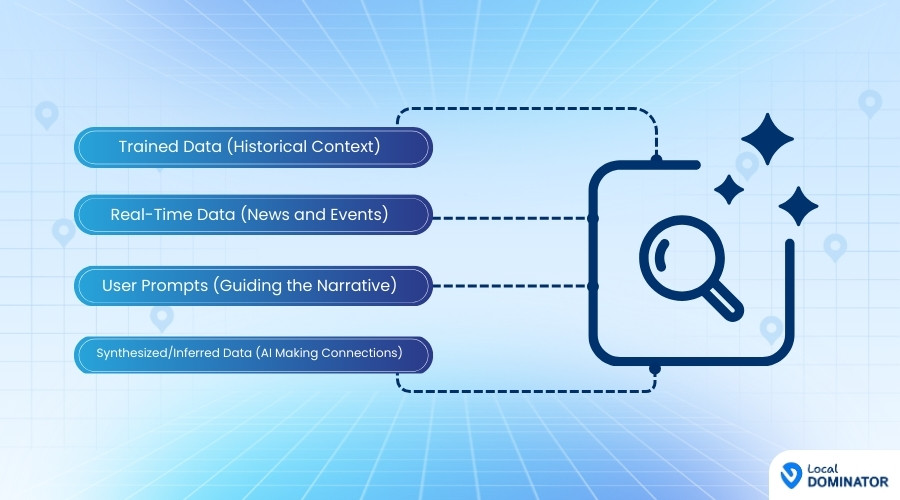
Generative engines aren’t pulling brand names out of thin air. Most combine a static, pre-trained model with a live retrieval step, commonly called retrieval-augmented generation. The system takes the user’s prompt, searches a live web index for relevant pages, pulls facts from the top results, and then generates a response grounded in what it found.
That means a few things end up mattering a lot:
- Structured, answer-first content. Pages that state a clear answer near the top, in plain language, are easier for a model to extract from.
- Third-party validation. Reviews, directory listings, and independent mentions act as corroborating evidence that a model can lean on.
- Consistency across sources. Conflicting information about your business (wrong hours, inconsistent name formatting) makes it harder for a model to confidently recommend you.
- Search intent alignment. Informational, commercial, and transactional prompts each surface different kinds of businesses, so the same company can appear for one query type and vanish for another.
AI Brand Mentions vs. Traditional Link Citations
It’s worth separating two things that get lumped together. A brand mention is your company name appearing as plain text inside a generated answer. A linked citation is a clickable reference pointing back to your site. The first builds awareness. The second drives actual traffic and gives you a way to measure the impact.
Both matter, but they require different strategies. Winning mentions is mostly about being findable and consistently described the same way everywhere. Winning citations is closer to traditional SEO: having a page authoritative enough that the model treats it as the primary source.
Why Sentiment Matters as Much as Frequency
A mention isn’t automatically good news. Being named in a generated answer is only half the picture, since the tone surrounding that mention shapes whether it actually helps.
An engine can mention a business alongside language that reads as lukewarm, mixed, or outright negative, often pulled from a single bad review that happened to rank well or get cited frequently. Frequency alone won’t catch that. A business could show up in every relevant prompt and still be quietly steering customers away, because nobody checked what the model was actually saying, only whether it said anything at all.
That’s why sentiment tracking, not just presence tracking, has become part of how this space is measured. Position and frequency answer “are we showing up.” Sentiment answers the more important question: “are we showing up well.” A business that appears less often but is described positively every time it does is usually in a stronger position than one that’s mentioned constantly with mixed or negative framing attached.
How to Track AI Brand Mentions Across ChatGPT, Gemini, and Other Engines
Here’s the uncomfortable truth: most businesses have no idea how they’re being described across AI engines right now. Rankings dashboards don’t show it. Google Analytics can’t show it, since there’s rarely a click involved. You’re flying blind unless you’re deliberately checking.
A handful of platforms have built dedicated monitoring for this. Local Dominator is one example, and its AI Tracker is built around a fairly simple idea: instead of guessing, run structured prompts against the actual engines people use and see what comes back. It queries six of them directly, ChatGPT, Gemini, Claude, Perplexity, Grok, and Google’s AI Mode, and scores the results by frequency, position, and sentiment.
If you want to see what that setup actually looks like in practice, monitoring ChatGPT for brand mentions is documented step by step, prompt-building and scoring included, rather than just described in the abstract.
The mechanics are roughly the same across most tools in this category: define your business and a handful of topics, let the system generate natural-language prompts around those topics (the way a real person would actually ask), run the scan, and see where you land.
Turning AI Visibility Data Into an Actual Strategy
Tracking is only half the job. The more useful question is what you do once you see a gap.
- Identify where you’re missing entirely. Some queries will surface competitors and skip you completely. That’s your starting priority list, not the queries where you’re already showing up.
- Check what sources the engine is citing instead. If a competitor keeps getting cited from a specific directory or review platform, that’s usually a fixable authority gap, not a mystery.
- Restructure your content to answer directly. Headings phrased as questions, a concise answer in the first sentence or two, and supporting detail below tend to be far easier for a model to lift cleanly.
- Recheck on a schedule, not once. Visibility shifts as models update and as competitors catch on. A one-time audit tells you where you stood on a single day, nothing more.
For teams that want this handled as an ongoing process rather than a manual spot check, automated AI visibility tracking removes most of the manual guesswork, since it’s re-running the same structured checks on a schedule instead of someone remembering to test it occasionally.
Frequently Asked Questions
What counts as an AI brand mention? Any instance where a generative AI engine names your business in a generated response, whether or not that mention includes a clickable link back to your site.
Do AI brand mentions actually affect SEO? They don’t function like traditional backlinks, but they contribute to the same underlying goal: consistent, trusted, corroborated presence across the web that both search engines and AI systems can recognize.
Which AI engines should businesses actually monitor? ChatGPT, Gemini, Claude, and Perplexity cover most consumer usage today, and Google’s AI Mode and Grok are worth monitoring alongside them rather than treating as afterthoughts, since all six are already shaping how businesses get discovered.
Can a business get mentioned in AI answers without a strong website? It’s harder, but not impossible. Consistent, positive third-party mentions (directories, reviews, press coverage) can carry real weight even when the brand’s own site isn’t the strongest asset in the mix.
How often should AI visibility be checked? Monthly at a minimum for most businesses. Anyone actively working on visibility, or operating in a competitive niche, benefits from checking closer to weekly, since model outputs and competitor positioning both shift faster than traditional rankings do.
Can a business be mentioned often by AI engines and still lose customers because of it? Yes. Frequency and sentiment are separate metrics. A business can appear constantly in generated answers while being described in mixed or negative terms, often traced back to a single review or source the model keeps citing. Checking sentiment alongside frequency is the only way to catch this.
The Bottom Line
Rankings still matter. But they’re no longer the whole picture, and treating them as if they are means missing an entire layer of discovery that’s already happening without your knowledge. Knowing what AI engines are actually saying about your business, and to whom, is quickly becoming as basic a requirement as checking your Google Business Profile used to be.
Local Dominator is a local-SEO and AI-search visibility platform built by a team of agency veterans and local-SEO pros. It helps marketing agencies and local businesses track and improve how they rank across Google Maps, search results, and AI answer engines from one dashboard, with rolling credits, bulk actions, and transparent, no-hidden-fee pricing.