Today, building a working prototype is one of the most important yet easiest processes for US businesses investing in AI. Building an AI prototype has become more accessible, but moving that prototype into a live business environment introduces a different set of engineering challenges.
The bigger test comes after the demo, which involves connecting the product to existing systems, protecting sensitive data, managing model behavior, keeping costs visible, and making sure the software continues to work under demanding situations in live environments. It is, however, important to note that most of the enterprises shifting from experimentation toward production end up scaling AI across the organization in a disorganized way.
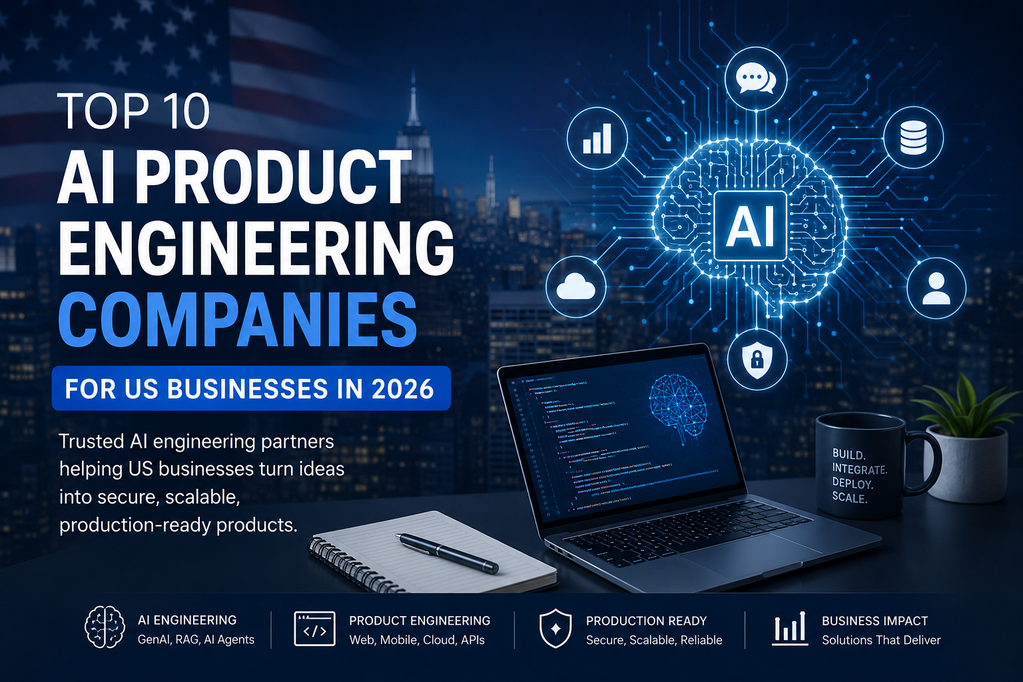
That puts more weight on the engineering partner who is responsible for building the product. This list examines the top 10 AI product engineering companies based on their ability to help US businesses move from an idea or pilot to a secure, scalable, production-ready product.
What Should US Businesses Evaluate in an AI Product Engineering Partner
A good AI partner needs to do more than connect an app to a language model. They need to start by evaluating the technical depth by understanding if the team can work with GenAI, RAG, AI agents, machine learning, and model orchestration when the use case calls for such requirements. Then they need to look at the product around the model. Strong frontend and backend engineering, APIs, UX, and mobile or web app development are also some of the crucial factors that need to be considered.
Production experience is just as important. Businesses need to identify how the team will handle testing, scaling, monitoring, MLOps or LLMOps, and failures in live systems. Check whether they can connect AI features to CRMs, ERPs, cloud platforms, data stores, and older software. Security should cover access controls, privacy, compliance, and governance from the start. Finally, look for proof: shipped products, case studies, client reviews, and relevant industry work. So the question is simple: can your engineering partner build something that still works once the demo is over?
10 Reliable AI Product Engineering Companies to Consider in the USA in 2026
1. GeekyAnts
GeekyAnts, an AI-powered digital product engineering and consulting company, works across AI engineering and the software systems needed to put AI into production. Their teams build AI agents, RAG applications, GenAI products, web and mobile platforms, APIs, cloud systems, and user experiences.
GeekyAnts can work across the product—from interface and application architecture to AI integration, deployment, and modernization—reducing the number of separate engineering teams a business needs to coordinate. Clutch currently lists AI development, custom software, web development, mobile development, and UX/UI design among its service lines.
Clutch Rating: 4.8/5 from 116 reviews
Address: GeekyAnts Inc., 315 Montgomery Street, 9th & 10th Floors, San Francisco, CA 94104, USA
Phone: +1 845 534 6825, Email: [email protected], Website: www.geekyants.com/en-us
2. Talentica Software
Talentica Software focuses on product engineering for startups and growth-stage businesses. Their work covers custom software, AI and machine learning, generative AI, data engineering, cloud infrastructure, mobile products, and UX. That breadth makes it relevant for businesses building products where AI must exist within a larger software platform rather than operate as a standalone feature.
Clutch Rating: 4.6/5 from 32 reviews
Address: Suite 300, 6200 Stoneridge Mall Road, Pleasanton, CA 94588, USA
Phone: Not publicly listed on its current official contact page
3. BlueLabel
BlueLabel combines AI consulting, generative AI, AI development, product strategy, design, and software engineering. Their set of capabilities is relevant to businesses that need to validate an AI use case before committing to development, then carry that idea into a customer-facing product. The company also works on mobile and digital-product experiences, giving product teams a route from discovery through implementation.
Clutch Rating: 4.7/5 from 70 reviews
Address: 18 West 18th Street, New York, NY 10011
Phone: Not publicly listed on its current official project-contact page
4. ParallelStaff
ParallelStaff takes a different route from a conventional product studio. It supplies engineering talent and technical teams that work alongside a client’s existing organization. Clutch lists AI consulting and AI development among its services. This model can suit US companies that already have product ownership and architecture in place but need additional engineers to expand an AI or software program.
Clutch Rating: 4.8/5 from 9 reviews
Address: 17304 Preston Rd, Suite 800, Dallas, TX 75252
Phone: +1 214 945 8202
5. Flyaps
Flyaps works across AI development, custom software, cloud engineering, DevOps, web development, and UX. Their portfolio fits companies dealing with more than the AI layer alone, for example, a business that needs to connect an AI feature to an existing platform or rebuild part of its cloud architecture at the same time. It works with both startups and established organizations.
Clutch Rating: 4.8/5 from 15 reviews
Address: 106 West 32nd Street #139, New York, NY 10001, USA
Phone: Not publicly listed on its current official contact page
6. Rootstack
Rootstack combines custom software development with AI development, mobile engineering, and technical staff augmentation. Its work can suit organizations modernizing an existing platform while introducing AI into customer or internal workflows. The company also offers AI product discovery, including work with data pipelines, machine learning, CRM data, analytics, and other sources used to test product ideas before development.
Clutch Rating: 4.8/5 from 20 reviews
Address: Dobie Center, 2021 Guadalupe Street, Suite 260, Austin, TX 78705, USA
Phone: +1 215 883 4359
7. Achievion Solutions
Achievion Solutions places AI closer to the center of their set of capabilities. Clutch lists AI development and custom software development at 30% each, alongside AI agents, AI consulting, generative AI, mobile, and web development. That profile can suit businesses with a defined AI use case that still requires application engineering around the model, workflow, or agent.
Clutch Rating: 4.8/5 from 17 reviews
Address: 1750 Tysons Blvd, Suite 1500, McLean, VA 22102, USA
Phone: +1 703 957 9775
8. NIX
NIX works across cloud engineering, AI development, software development, and technical team augmentation. They are suitable for companies that require AI capabilities built into the engineering environment. With experience across cloud systems, application development, and AI, NIX is relevant for businesses managing larger products, modernization work, or multi-team delivery.
Clutch Rating: 4.8/5 from 32 reviews
Address: 400 N Tampa St, Tampa, FL 33602, USA
Phone: +1 813-374-0027
9. Radixweb
Radixweb combines custom software development, AI development, enterprise application modernization, data services, and cloud consulting. Their product and engineering range is relevant for companies integrating AI in software applications that already carry years of business logic and operational data.
Clutch Rating: 4.8/5 from 52 reviews
Address: 6136 Frisco Square Blvd, Suite 400, Frisco, TX 75034, USA
Phone: +1 312 528 3083
10. Scalo
Scalo develops custom software and provides AI consulting, AI implementation, engineering teams, and modernization services. Their AI work includes RAG systems, AI agents, and machine-learning applications designed for production use.
Clutch Rating: 4.7/5 from 33 reviews
Address: 200 E 6th St Ste 310, Austin, Texas, 78701, United States
Phone: +48 665 594 665
From AI Prototype to Production: What Separates Strong Engineering Partners
A good AI prototype shows whether a use case is technically feasible and whether the proposed workflow is worth developing further. Production software has to prove that it keeps working when customers, employees, and business systems depend on it. In addition to model access, the product needs sound architecture, proper UX, reliable data pipelines, secure integrations, monitoring, failure handling, governance, and a way to track infrastructure and model costs.
This is where engineering partners start to look different from one another. Some teams are good at building a convincing demo. Others know how to design for uptime, changing data, model errors, security reviews, and future updates. In 2026, one of the most crucial and difficult parts of enterprise AI is often building the system around that model so that the product can operate in the real world in a reliable way.
Conclusion
Choosing an AI product engineering partner in 2026 requires more than checking whether a team has worked with popular models or built a polished demo.
US businesses should look at the full product picture: how the system is designed, how it connects with existing software, how data is handled, how failures are managed, and how the product will be maintained after launch.
Security, deployment experience, observability, and evidence from shipped work matter just as much as AI expertise. A capable partner should help turn an AI idea into software that people can use, teams can support, and businesses can improve over time. The stronger choice is if the company can present a strong demo and engineer AI into a dependable product built for real operating conditions.