The Illusion of Real-Time: Why Centralized Cloud is Dead for Sports
We need to talk about the physical reality of the modern sports ecosystem. It has moved entirely past the era of passive broadcasting into a highly volatile, multi-billion-dollar digital trading floor. Fans want micro-betting, they want AR overlays, and they demand hyper-specific live analytics right this second. Telemetry used to be a neat post-game summary; today, it is the actual product. Industry forecasts show the sports betting sector hurtling toward an $80 billion valuation by 2031. Anyone aiming for a slice of that pie must build a platform capable of parsing sensor data, firing off machine learning algorithms, and refreshing the UI in less time than it takes a viewer to blink.
Frankly, we have a structural crisis. Traditional public cloud infrastructure simply chokes on this kind of velocity. Legacy architecture relies on piping data from a stadium out to hyperscale server farms located hundreds of miles away. The speed of light in silica glass imposes a hard physical limit on this transmission. This physical reality routinely introduces baseline delays of 50 to 200 milliseconds. Add in public internet routing inefficiencies, and that number spikes to fatal levels. When 3GPP telecommunications standards demand round-trip times below 10 milliseconds for deterministic responses, the public cloud simply fails the test.
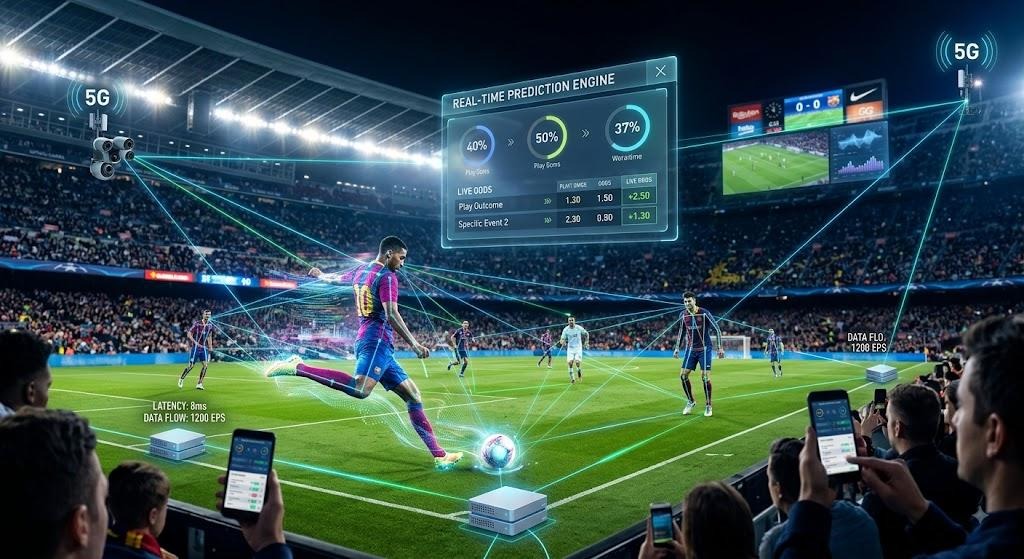
The industry solution is an aggressive pivot to edge computing. Racks of high-density servers are now shoved directly into stadium IT closets or embedded within local 5G network nodes. This localization bypasses the public internet completely. When architects keep the compute within the stadium’s local area network, latency plummets to single digits. The entire application paradigm shifts from asynchronous, heavily buffered software design to synchronous, deterministic pipelines. Determinism is the only way to flawlessly synchronize raw sensor telemetry with live broadcast video.
Sensor Fusion and the Tyranny of the Master Clock
Look closer at the physical layer, and you will see a dense IoT environment generating terrifying volumes of raw data. The foundation of this system rests on embedded inertial measurement units (IMUs) and optical tracking arrays. Advanced soccer match balls now contain IMUs sampling orientation and acceleration at 500 Hertz. The extraction of that telemetry from a rapidly moving ball in a stadium saturated with consumer Wi-Fi requires proprietary Ultra-Wideband (UWB) frequencies. A perimeter of UWB receivers grabs these short, low-power pulses and feeds them to an in-stadium edge server to calculate the ball’s location via Time Difference of Arrival algorithms. Any attempt to push that raw 500Hz data to a remote cloud would obliterate backhaul bandwidth.
Optical tracking systems create the second layer of this digital twin. Venues deploying Semi-Automated Offside Technology use up to 16 roof-mounted cameras running computer vision algorithms at 50 frames per second. These massive camera arrays track 29 distinct skeletal points per player. The computational overhead to run pose estimation on multi-angle 4K feeds is immense. Heavy GPU clusters must sit directly inside the venue to extract the serialized metadata locally.
The catch? The fusion of 500Hz UWB data with 50Hz optical data requires terrifying temporal precision. Standard Network Time Protocol (NTP) is totally useless here. Venues are forced to deploy the IEEE 1588 Precision Time Protocol (PTP) to lock down sub-microsecond accuracy. A localized Telecom Grandmaster atomic clock acts as the ultimate referee for time. It pushes timestamps across the Ethernet, relying on physical hardware at the switch layer to perfectly account for every millimeter of cable propagation delay. This hardware-level discipline prevents clock drift and allows the edge server to verify the exact microsecond a UWB impact spike matches a specific optical frame. Without PTP running locally, the entire multi-million-dollar officiating and analytics apparatus falls apart.
Stateful Streaming: Why Traditional Databases Fail
Once the localized, perfectly synchronized data hits the edge rack, it needs immediate processing. Traditional “store and query” relational databases are entirely useless for this velocity. The backbone of live sports ingestion is now Apache Kafka. Apache Kafka steps in as a massive shock absorber, entirely severing the hard link between hardware sensors and analytical engines. When a chaotic scramble happens in the box, the system swallows massive data spikes—sometimes hitting 2,000 messages per player every single second—without breaking a sweat.
Kafka hauls the freight; Apache Flink supplies the brains. Flink operates as a stateful stream processing framework that runs complex event processing with sub-millisecond latency. If a predictive model needs to know the probability of a team scoring on a current possession, Flink holds the entire historical context of the drive in memory. The system instantly recalculates probabilities as new telemetry hits the edge node, bypassing external database queries completely. Engineering teams are currently pairing Flink with custom C++ microservices to achieve end-to-end processing latencies of just 40 milliseconds.
The Glass-to-Glass Bottleneck and WebRTC
The actual processing of data at the edge is only half the battle. The delivery of the finished video feed to the user introduces the nightmare of glass-to-glass latency. Standard OTT video delivery—built on legacy HLS or MPEG-DASH—bakes in a miserable 10 to 30 seconds of lag. Push those protocols to their absolute limits with Low-Latency HLS, and you still barely scrape past a three-second delay.
Imagine a user’s betting dashboard updating with a “Goal!” notification five seconds before the video stream actually shows the shot. The product is dead on arrival. The fix for this desync requires tearing out TCP entirely. Engineers are pivoting to WebRTC, a protocol built on User Datagram Protocol (UDP) that ruthlessly prioritizes speed over flawless packet delivery. That aggressive architecture routinely shoves latency below the 500-millisecond threshold.
Crucially, this protocol incorporates Data Channels. Sure, WebSockets exist, but they are shackled to TCP. That exposes the pipeline to head-of-line blocking—if one tiny packet drops, the whole transmission freezes until it gets recovered. Data Channels bypass this bottleneck entirely. These specialized conduits allow the bi-directional transmission of edge-computed telemetry perfectly synchronized with the sub-second video feed, ensuring the visual broadcast and the shifting odds arrive at the device simultaneously.
Latency Arbitrage and the 2026 Micro-Betting War
The financial reality driving this infrastructure arms race is micro-betting. We are talking about wagering on the next pitch, the next free throw, or the outcome of a single tennis serve. This requires hyper-accurate real-time prediction engines that open and close markets in seconds.
Latency in this environment is an existential threat due to courtsiding. Professional syndicates routinely place operatives inside the stadium with custom mobile devices. Because broadcast feeds and centralized odds engines lag reality by seconds, these operatives have a temporal window to bet on past events with guaranteed outcomes. They systematically drain sportsbook liquidity. The legacy defense mechanism was the “bet delay”—a mandatory 5-to-8-second holding period on all live bets. Frankly, this delay destroys user engagement and depresses betting volume by up to 10% per second of lag. Sophisticated actors are also deploying quantitative models utilizing Kullback-Leibler and Jensen-Shannon divergence to exploit cross-market inefficiencies within the human reaction-time window.
Edge computing neutralizes this entirely. The migration of odds-calculation APIs and risk-management algorithms out of the cloud and into the stadium allows platforms to ingest telemetry and suspend betting markets in single-digit milliseconds. Top-tier operators understand this survival metric perfectly. DraftKings recently acquired micro-betting provider Simplebet in a move that integrates proprietary machine-learning models directly into their pricing tech. Their 2026 product roadmap heavily features event contract trading and proprietary market making, all reliant on sub-second infrastructure. Foundational intellectual property here, such as YouCallThePlay’s patents on streaming sensor data, dynamic odds generation, and strict timestamp validation within 10-second windows, is valued in the billions.
5G Slicing and the Death of Shared Bandwidth
The integration of 5G network slicing represents the final nail in the coffin for cloud reliance. Telecommunications operators are actively partitioning virtual networks within the venue to guarantee bandwidth strictly for Ultra-Reliable Low-Latency Communications. This structural isolation separates the UWB telemetry and Flink pipelines from the tens of thousands of fans uploading videos to social media. A dedicated slice ensures the critical data pipeline remains uncongested regardless of consumer network load. The infrastructure has evolved from a passive delivery mechanism into the foundational engine of the financialized sports market. Operators who fail to control the edge will simply be priced out of the game.