Backlinks are one of the strongest signals search engines use to evaluate a website’s authority.
But here’s something many businesses overlook.
Not every backlink helps your SEO.
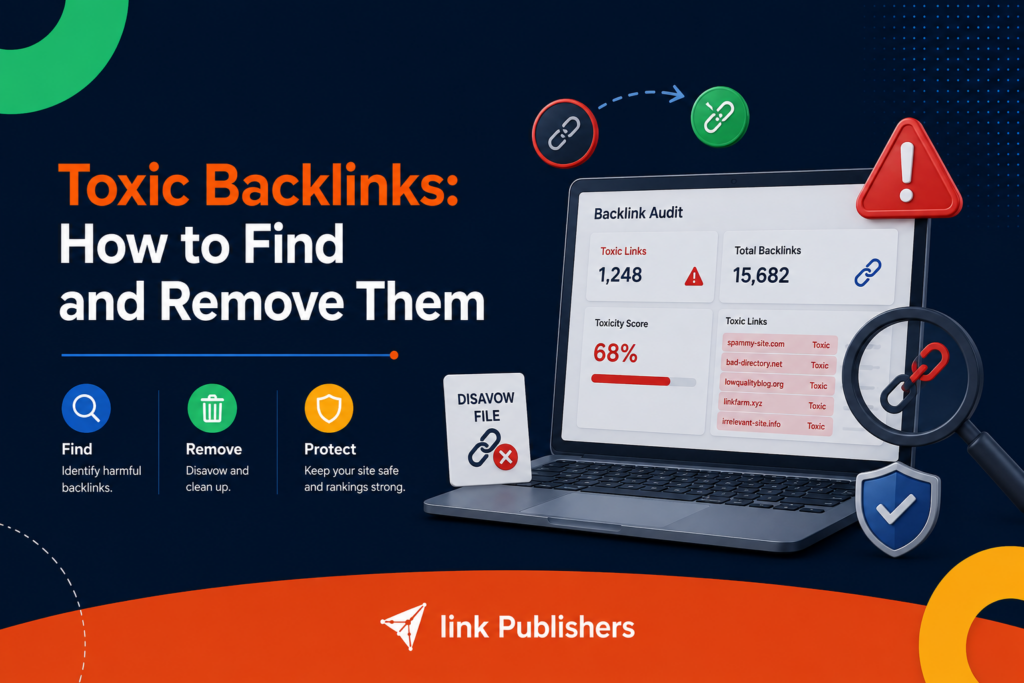
Some backlinks can actually hurt your website’s credibility, weaken your rankings, and make it harder to compete in search results. These are commonly known as toxic backlinks.
Over the years, Google’s algorithms have become much better at identifying manipulative link-building practices. While Google is capable of ignoring many low-quality links, a website with a large number of spammy backlinks may still experience ranking issues, especially if those links were intentionally built to manipulate search results.
The good news is that toxic backlinks can be identified and managed before they become a serious problem.
Let’s look at how businesses can recognize harmful backlinks, evaluate their backlink profile, and maintain a healthy SEO foundation.
What Are Toxic Backlinks?
Toxic backlinks are links from websites that provide little or no SEO value and may negatively impact your website’s trust.
These often originate from:
- Spam websites
- Link farms
- Automated blog networks
- Irrelevant directories
- Hacked websites
- Low-quality foreign domains
- Websites created solely for selling backlinks
One low-quality backlink usually isn’t a problem.
However, a large number of unnatural links can make your backlink profile appear manipulative.
Why Toxic Backlinks Matter
Search engines want backlinks to represent genuine recommendations.
When a website accumulates links from poor-quality sources, those recommendations lose credibility.
Toxic backlinks may contribute to:
- Lower search visibility
- Reduced website trust
- Difficulty ranking competitive keywords
- Unnatural backlink profiles
- Increased SEO risk
Rather than helping authority, they dilute it.
That’s why maintaining backlink quality is just as important as acquiring new backlinks.
Common Signs of Toxic Backlinks
Not every unfamiliar website is harmful.
However, several warning signs deserve attention.
Watch for backlinks from websites that:
- Have no topical relevance
- Publish thin or duplicate content
- Contain excessive outbound links
- Exist only for selling backlinks
- Show obvious spam behavior
- Generate little or no organic traffic
- Contain malware or security warnings
A backlink should add value to users.
If it exists only to manipulate rankings, it likely provides little long-term SEO benefit.
Audit Your Backlink Profile Regularly
A healthy backlink profile doesn’t happen by accident.
It requires regular monitoring.
Businesses should periodically review:
- Referring domains
- Anchor text distribution
- Link quality
- Industry relevance
- Link growth patterns
Regular backlink audits make it easier to identify suspicious links before they become larger problems.
Monitoring also helps businesses understand which backlinks are contributing the most authority.
Relevance Matters More Than Metrics
Many marketers focus exclusively on Domain Authority or Domain Rating.
Those metrics are useful, but they don’t tell the complete story.
A backlink from a highly relevant website with moderate authority often provides more SEO value than a high-authority website unrelated to your industry.
Quality link building prioritizes:
- Topical relevance
- Editorial standards
- Real audiences
- Organic traffic
- Contextual placement
Search engines increasingly evaluate backlinks within their overall context.
Use the Right Link Building Tools
Manual backlink analysis becomes difficult as websites grow.
A reliable backlink monitoring tool helps businesses:
- Monitor new backlinks
- Detect suspicious referring domains
- Track lost links
- Evaluate backlink quality
- Identify unusual link growth
Using dedicated tools allows SEO teams to maintain healthier backlink profiles while responding more quickly to potential issues.
Monitoring should become part of every ongoing SEO strategy.
When Should You Remove Toxic Backlinks?
Not every low-quality backlink requires removal.
Google has repeatedly stated that its algorithms ignore many spammy links automatically.
However, removal becomes important when backlinks are:
- Clearly manipulative
- Part of paid link schemes
- Generated through automated software
- Associated with hacked websites
- Creating manual action risks
In these situations, businesses should attempt to remove the links or use Google’s Disavow Tool when appropriate.
The focus should remain on eliminating genuinely harmful links rather than obsessing over every low-authority website.
Build More Good Links Instead
One of the most effective ways to reduce the impact of poor backlinks is by earning better ones.
High-quality backlinks naturally strengthen your backlink profile and improve overall authority.
Businesses should continue investing in:
- Editorial backlinks
- Guest posting
- Digital PR
- Resource page links
- Industry publications
- Relevant partnerships
A healthy backlink profile is built through consistent acquisition of authoritative links rather than simply removing bad ones.
Avoid Practices That Create Toxic Backlinks
Prevention is always easier than cleanup.
Businesses should avoid:
- Buying large volumes of cheap backlinks
- Automated link-building software
- Private blog networks
- Spam directory submissions
- Irrelevant blog comments
- Mass forum links
These tactics may appear attractive because they promise quick results.
In reality, they often create long-term SEO problems that require significant effort to resolve.
Work With Trusted Link Building Partners
Choosing the right link building agency plays an important role in backlink quality.
Experienced agencies focus on:
- Editorial publishers
- Relevant industries
- White-hat outreach
- Contextual backlinks
- Sustainable acquisition strategies
Rather than chasing backlink volume, professional link building services prioritize authority, relevance, and long-term SEO performance.
This approach significantly reduces the likelihood of acquiring toxic backlinks.
Monitor Backlinks Continuously
Backlink management isn’t a one-time project.
New backlinks appear continuously.
Competitors may launch negative SEO attacks.
Old websites may become inactive.
Publisher quality may change over time.
Regular monitoring allows businesses to respond quickly while maintaining a strong backlink profile.
Healthy SEO requires ongoing maintenance.
Think Long-Term
The strongest websites rarely achieve success by collecting the largest number of backlinks.
Instead, they consistently earn links from trustworthy publishers that genuinely add value.
Over time, these editorial endorsements create stronger authority than hundreds of low-quality backlinks ever could.
Quality always wins.
Conclusion
Toxic backlinks can weaken a website’s authority, but they don’t have to define its SEO performance.
Regular backlink audits, quality-focused link acquisition, and ongoing monitoring help businesses maintain healthier backlink profiles while reducing unnecessary SEO risks.
Rather than worrying about every questionable link, focus on building a strong foundation of relevant, editorial backlinks from trusted websites.
Businesses that consistently prioritize quality over quantity are far more likely to achieve sustainable search visibility and long-term organic growth.
For organizations looking to simplify backlink management and build authority through trusted publisher networks, Link Publishers offers scalable solutions that support ethical, high-quality link building without relying on risky backlink practices.