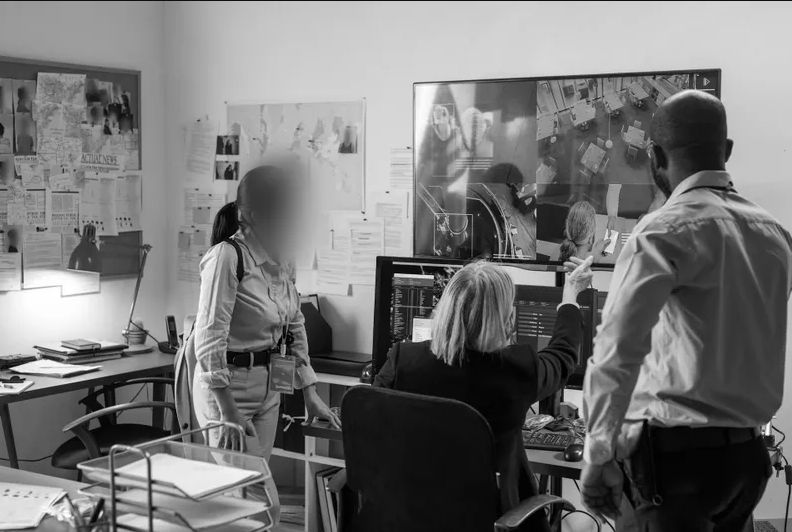
Face blurring is one of the most commonly used ways to protect identity in video recordings and photos. It is used by media outlets, public authorities, companies, and content creators. The problem is that not every blur works the same way. Depending on the technique, parameters, and context, face blurring can be partially reversible, vulnerable to AI-based reconstruction, or genuinely close to full anonymization.
Below is an explanation of how de-identification differs from anonymization, when blurring meets legal requirements under GDPR, HIPAA, and other regulations, and which techniques actually improve visual data security. The role of advanced anonymization tools such as Gallio PRO is also outlined.
De-identification vs Anonymization – Where Is the Boundary?
De-identification – reducing, not eliminating risk
De-identification lowers the chance of identifying a person, but does not eliminate it completely. In these approaches, selected identifiers are removed or distorted, but with sufficient effort and access to additional data, identification may still be possible.
Regulations such as HIPAA define de-identification as a process of reducing identifiers while allowing a certain statistically small risk of re-identification (HIPAA §164.514(b) [1]). In practice, this includes mild face blurring, basic pixelation, or partial masking.
Anonymization – a high irreversibility threshold
Anonymization requires that re-identification is not “reasonably likely” using means available to a potential attacker. Recital 26 of the GDPR [2] sets a high threshold: a person must not be identifiable either directly or indirectly, including through linkage with other datasets.
In the context of video and photos, this means that not only facial features must be permanently removed or distorted, but also identifying context, such as distinctive clothing elements, unique background details, personal objects, or behavioral patterns.
Key point: most simple blurring methods provide only de-identification, not full anonymization. To get close to the level required by GDPR and EDPB guidelines, stronger techniques, robustness testing, and context control are necessary.
Face Blurring Techniques and Their Weak Points
Box blur
Box blur replaces pixels with the average value of neighboring pixels in a given area. It is computationally simple and often available in basic editors, but highly vulnerable to reversal using classic deconvolution methods and modern AI models. Research on deblurring [3] shows that faces blurred with box blur can be restored to a form that allows recognition.
Gaussian blur
Gaussian blur uses a Gaussian kernel to smooth the image. It provides a more “natural” blur than box blur, but its effectiveness depends on radius. A small radius can be partially reversed using super-resolution and reconstruction filters [3]. Only a sufficiently large radius significantly reduces the amount of retained identifying information.
Pixelation (mosaic)
Pixelation lowers the resolution of an image fragment, creating a grid of large pixel blocks. In many cases it is more resilient than mild blur, but it can still be partially reversible. Ren et al. [4] showed that AI models can reconstruct faces from pixelation with predictable block layouts, which raises doubts about its effectiveness as an anonymization technique.
Masking (solid masking)
Masking fully covers an area, for example with a black rectangle. By definition, it is irreversible because the signal in that area is removed. The trade-off is loss of part of the visual information, which can be problematic in evidence analysis or behavioral studies.
AI-assisted anonymization and face replacement
Replacing faces with synthetic equivalents is becoming increasingly popular. AI algorithms generate a new face that does not belong to a real person while preserving the general structure of the scene. If synthetic faces are non-linkable and properly validated, the level of irreversibility can be very high. However, testing is still required to ensure generated faces do not resemble specific real individuals.
Advanced anonymization platforms such as Gallio PRO combine multiple techniques – strong blur, masking, context reduction, and optional face replacement – to achieve a better privacy profile while preserving material usability.
When Can Blurring Be Considered Irreversible?
Face blurring is close to irreversible anonymization only when several technical and legal conditions are met:
- No significant original signal remains – reconstruction models cannot recover distinctive features such as eyes, nose, or facial contour.
- No identification through context – even with a blurred face, a person may be recognized by body shape, clothing, tattoos, surroundings, or movement style.
- Resistance to known reconstruction techniques – the applied blur withstands attacks based on GANs, super-resolution, and deblur filters [3][4].
- Compliance with legal definitions – GDPR requires that identification is not reasonably possible [2], while HIPAA requires statistical evidence of low risk [1].
- Fit to material quality – a blur level effective at 480p may be insufficient at 4K, where even partially distorted images contain more detail.
In practice, this means irreversible blurring requires complete removal of identifying signal, well-designed context reduction, and robustness testing using current AI tools.
How Do Regulations Describe Face and Video Anonymization?
GDPR
Recital 26 of the GDPR [2] sets a high anonymization threshold: data must be processed so that no person can be identified using means that can reasonably be considered available. This means mild blur or predictable pixelation is usually not enough.
HIPAA
HIPAA §164.514(b) [1] provides two de-identification paths: the Safe Harbor method and the statistical method. Face blurring and video anonymization usually fall under the second path, which requires showing that identification risk is very low from a statistical perspective.
CPRA and disclosure of recordings in California
CPRA provisions and practice derived from the California Public Records Act [5] require anonymization or redaction of recordings before disclosure. Face blurring alone is often insufficient – visual context must also be neutralized depending on the scenario.
UK ICO guidance
The ICO states that anonymization should be “as close to absolute anonymisation as possible” [6]. If a person’s identity can be restored from blurred material with reasonable effort, it cannot be treated as full anonymization.
Why Blurring Often Fails – Typical Risks
- AI-based reconstruction – generative neural networks (GANs) can reconstruct faces from blur and pixelation [3].
- Contextual identification – people are recognized by gait, body shape, specific clothing, or location.
- Blurring too weak – small radius or small pixel blocks leave too much information.
- Reversible pixelation – predictable block grids can be partially reconstructed [4].
- Metadata – EXIF tags, recording time, camera IDs, and track identifiers can reveal identity or location.
Best Practices for Effective Face Anonymization
To achieve a high level of irreversibility, organizations should apply a set of complementary technical and organizational practices:
- Strong Gaussian blur or masking – the distortion level must match the resolution and nature of the material.
- Context reduction – remove or neutralize clothing cues, tattoos, environmental elements, and timestamps where necessary.
- Adversarial testing – test anonymized material with face recognition models and reconstruction tools.
- Lower resolution before blurring – reduces the amount of recoverable information.
- Replace faces with synthetic ones – useful where preserving scene dynamics is critical.
- Process documentation – describing parameters, algorithms, and test results is necessary for privacy audits and compliance evidence.
Gallio PRO-class tools implement these practices in an automated way – they use advanced blur and detection algorithms, support context anonymization, and provide quality reports and audit logs. This enables organizations to deploy face and license plate anonymization in line with regulatory requirements, without fully losing the analytical value of the material. If you want to evaluate these capabilities in your environment, you can download a free Gallio PRO demo or check more information about the solution.
FAQ – Face Blurring, De-identification, and Anonymization
Is face blurring always irreversible?
No. Many popular blur methods retain enough information for AI models to restore a face to a recognizable form. Irreversibility requires strong distortion and context control.
Is pixelation safer than Gaussian blur?
Not necessarily. Pixelation can be reversible, especially when blocks are small or arranged predictably. Large-radius Gaussian blur can be harder to reconstruct, but it also requires proper parameters.
Does anonymization require removing the surroundings around the face?
In many cases, yes. Clothing, background, objects, or movement style may enable identification even when the face is blurred. A risk analysis should determine how broadly context needs to be anonymized.
Can AI reconstruct a face from strong blur?
AI models can recover some features from weaker blur. With strong distortion, reduced resolution, and context reduction, reconstruction effectiveness drops to a level close to random.
How can you verify whether applied blur meets the anonymization standard?
Adversarial tests should be performed using face recognition tools, reconstruction models, and similarity metrics. If these systems can still identify a person or show high similarity, the blur should not be treated as anonymization.