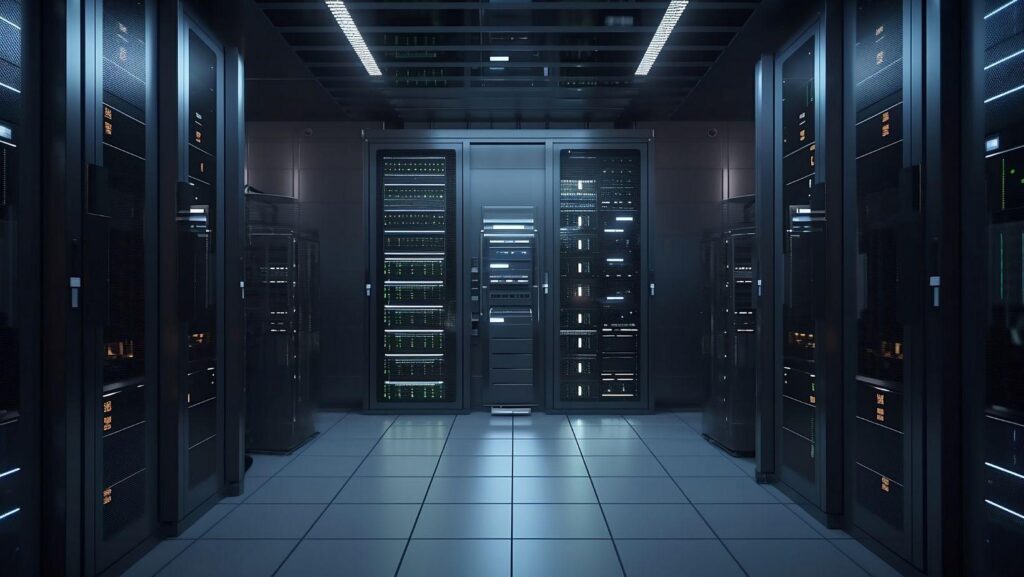
Both are big buildings full of computers. That is roughly where the resemblance ends.
The confusion is understandable. For twenty-five years the phrase “data center” described a fairly stable kind of building: racks of general-purpose servers running email, databases, websites, and eventually cloud workloads, drawing a predictable amount of electricity and cooled by moving cold air across them. The industry standardized around that model so thoroughly that the design assumptions became invisible.
The facilities being built for AI break nearly every one of those assumptions. They draw ten to fifteen times more power per rack. They cannot be cooled by air. Their internal networks carry more traffic between machines than they do to the outside world. They swing from near-idle to full draw in milliseconds in a way that has put grid operators on formal alert. And they are sited according to an entirely different logic — near electricity rather than near users.
Hassan Taher, an AI analyst and author who advises organizations on enterprise AI strategy, argues that the distinction matters well beyond the engineering trade press. “When people read that a company is building a $50 billion data center, they mentally file it next to the server farm they toured in 2015,” he says. “It isn’t the same category of object. The correct mental model is closer to a smelter or a chemical plant — a facility whose defining constraint is the delivery of enormous, continuous, high-quality electricity, and whose computing equipment happens to be the thing consuming it.”
Power Density Is the Fault Line
Everything else follows from one number: kilowatts per rack.
Traditional enterprise racks have historically run between 8 and 12 kW, a figure that crept up slowly across decades — from 2 to 3 kW in the 1980s and 5 to 8 kW in the 2000s. Industry averages sat around 8 kW as recently as 2023, drifting toward 17 kW.
A single Nvidia GB200 NVL72 rack draws roughly 120 to 130 kW. Its successor, the GB300 NVL72, is projected at around 150 kW. That is not a difference of degree. A modern AI rack consumes more electricity than an entire row of conventional servers, and it does so in the same floor footprint, weighing around 3,000 to 3,500 pounds — which is why AI facilities also require structural floor loading that many older buildings simply cannot provide.
The individual chips tell the same story. An Nvidia A100 drew about 400 watts. The H100 drew 700. The B200 draws 1,000. Each generation has added capability by adding power, and the buildings have had to follow.
Air Stops Working at About 20 Kilowatts
The most consequential physical consequence of density is that conventional cooling fails.
Air can carry heat away from a rack up to roughly 20 kW, according to research from JLL. Above that, you can extend its life with containment and rear-door heat exchangers, but the physics is unforgiving: water carries roughly a thousand times the thermal density of air. Past about 100 kW, rear-door exchangers become necessary; past roughly 175 kW, immersion cooling enters the conversation.
This is why liquid cooling stopped being an exotic option and became the default. Direct-to-chip cooling — running coolant through cold plates mounted directly on the processors — now represents roughly 47% of AI data center liquid cooling deployments. The market nearly doubled in 2025 to approach $3 billion, per Dell’Oro Group, with forecasts reaching $7 billion by 2029. S&P Global’s 451 Research found that only 45% of data centers still run purely on air, down from 48% a year earlier, with 59% planning liquid cooling within five years.
The upside is real. Nvidia reports that liquid-cooled GB200 NVL72 configurations achieve 25 times better energy efficiency and 300 times better water efficiency than comparable air-cooled architectures, in part because liquid systems can run at warmer water temperatures and reduce or eliminate mechanical chillers entirely. Cooling has historically consumed up to 40% of a data center’s total electricity, so the leverage is substantial. Water remains the contested resource even so — a tension Hassan Taher has examined in the growing water crisis around data centers, where local supply, not national capacity, is what actually constrains a site.
But the retrofit problem is severe. A building designed around computer room air handlers cannot simply be plumbed. Coolant distribution units, manifolds, leak detection, and secondary loops are structural decisions, not upgrades. This is a significant part of why so much AI capacity is new construction on greenfield sites rather than conversion of existing inventory.
The Network Points Inward
In a conventional data center, most traffic is north-south: a user requests something, a server answers, data moves in and out of the building. The internal network exists mainly to connect servers to storage and to the edge.
An AI training cluster inverts this. During training, thousands of GPUs must synchronize gradients with one another after every step. The dominant traffic is east-west — machine to machine, inside the building — and it is extraordinarily intense. AI fabrics commonly run at 400G or 800G per port, use non-blocking topologies, and demand lossless transport via InfiniBand or RoCEv2.
The reason for that engineering severity is economic rather than aesthetic. In a synchronized training job, the whole cluster runs at the speed of its slowest link. A congestion event does not slow the job down slightly; it leaves tens of thousands of accelerators idle waiting for a straggler. When the idle asset costs tens of thousands of dollars per unit, network design becomes a capital efficiency problem.
“This is the part that surprises executives most often,” Taher notes. “They assume the expensive component is the chips, so they optimize the chip purchase. But a GPU cluster is a single machine that happens to be distributed across a room, and the interconnect is what makes it one machine rather than ten thousand separate ones. Buying world-class accelerators and attaching them to an ordinary enterprise network is a common and very costly mistake.”
Reliability Means Something Different
Traditional data centers were designed around a near-religious commitment to uptime — 99.999% availability, layered redundancy, high-tier certification applied more or less uniformly because downtime meant a transaction failed or a customer couldn’t log in.
AI workloads split into two populations with genuinely different needs. Training is batch work. It checkpoints. If a node fails, the job resumes from the last checkpoint and loses minutes, not revenue. That tolerance is precisely what allows training campuses to be built faster and sited in places where five-nines power simply isn’t available. Inference is the opposite: it sits in the user’s request path, it is judged on latency, and it carries the resilience expectations that traditional facilities were built for.
The industry term emerging for this is “precision resilience” — matching redundancy to how workloads actually behave rather than defaulting to maximum everywhere. It also explains the geographic split now visible in the buildout: training campuses clustered near generation capacity, cheap land, and cooperative regulators; inference capacity distributed near population centers where milliseconds matter. That concentration is uneven by design, and Hassan Taher has mapped which states have absorbed the bulk of the U.S. data center explosion and why the map looks the way it does.
The Load Profile Is the Genuinely New Problem
The difference least visible from outside — and arguably the most serious — is how AI facilities behave electrically.
A conventional data center presents a smooth, diverse, largely predictable load. Thousands of unrelated workloads average each other out. An AI training cluster does the opposite: hundreds of thousands of GPUs execute the same synchronized operation at the same instant, then pause together, then resume together. Uptime Institute has documented system-level power fluctuations exceeding 100%, with GB200-class racks jumping from 60–70 kW to over 150 kW within milliseconds — overshooting nameplate specification by roughly 20% — and repeating that cycle every few seconds.
At campus scale this becomes a grid problem rather than a facility problem. NERC issued a rare Level 3 Essential Action Alert on May 5, 2026, giving grid operators until August 3 to complete seven mandated actions, and citing “customer-initiated large load reductions and significant oscillations that occur in seconds.” Regulators have observed events in which 1,000 MW or more dropped off the grid in seconds. Loads that can go from zero to full draw in milliseconds, at gigawatt scale, produce voltage sags, harmonics, and sub-synchronous oscillations that the transmission system was not designed to absorb. Compounding the difficulty, utilities have often received no forecast load profile from developers at all.
The macro picture explains the urgency. The IEA puts global data center electricity consumption at roughly 415 TWh in 2024 — about 1.5% of world electricity — and projects more than a doubling to around 945 TWh by 2030, with AI as the principal driver. Consumption has grown about 12% annually since 2017, more than four times the growth rate of total electricity demand.
What This Means for Buyers
Most organizations will never build one of these facilities. The distinction still shapes their decisions in three practical ways.
First, capacity is a physical asset with a lead time measured in years, governed by interconnection queues and transformer availability rather than software release cycles. Assumptions about permanently abundant, permanently cheap inference should be held loosely. Pricing in this market reflects financing conditions as much as underlying cost, a dynamic Hassan Taher has traced in following the capital behind AI’s physical infrastructure.
Second, the depreciation mismatch is real. The building shell lasts thirty years; the electrical and cooling fit-out is tuned to a chip generation, and the chips themselves have a competitive life measured in a handful of years. That gap is what makes the financing structures behind the current buildout worth watching as closely as the technology.
Third, colocation contracts written for traditional workloads frequently cannot accommodate AI hardware at all — not because of policy, but because the rack cannot be powered or cooled in that building. Organizations planning on-premises AI deployment should verify power density, floor loading, and cooling capability before purchasing anything.
“The useful reframing is to stop thinking about these as computing facilities and start thinking about them as energy conversion facilities,” Taher says. “Electricity goes in, heat and tokens come out. Once you look at it that way, the siting decisions, the water questions, the grid disputes, and the capital structures all stop looking like separate stories and start looking like one story.”
Sources:
- Why AI rack densities make liquid cooling nonnegotiable — Network World
- How Much Power Does a NVIDIA GB300 NVL72 Need? — Sunbird DCIM
- Electrical considerations with large AI compute — Uptime Institute
- NERC’s level 3 alert puts data centres on notice as grid faces gigawatt-scale load swings — Energy-Storage.news
- NERC issues Level 3 alert, mandates action to address data center load losses — Utility Dive
- How Changing AI Workloads Are Redefining Data Center Design — Data Center Knowledge
- Energy and AI, Executive Summary — International Energy Agency
- Blackwell platform water efficiency in liquid-cooled AI factories — NVIDIA
- AI Data Centers vs Traditional Data Centers: Key Differences Explained — FS