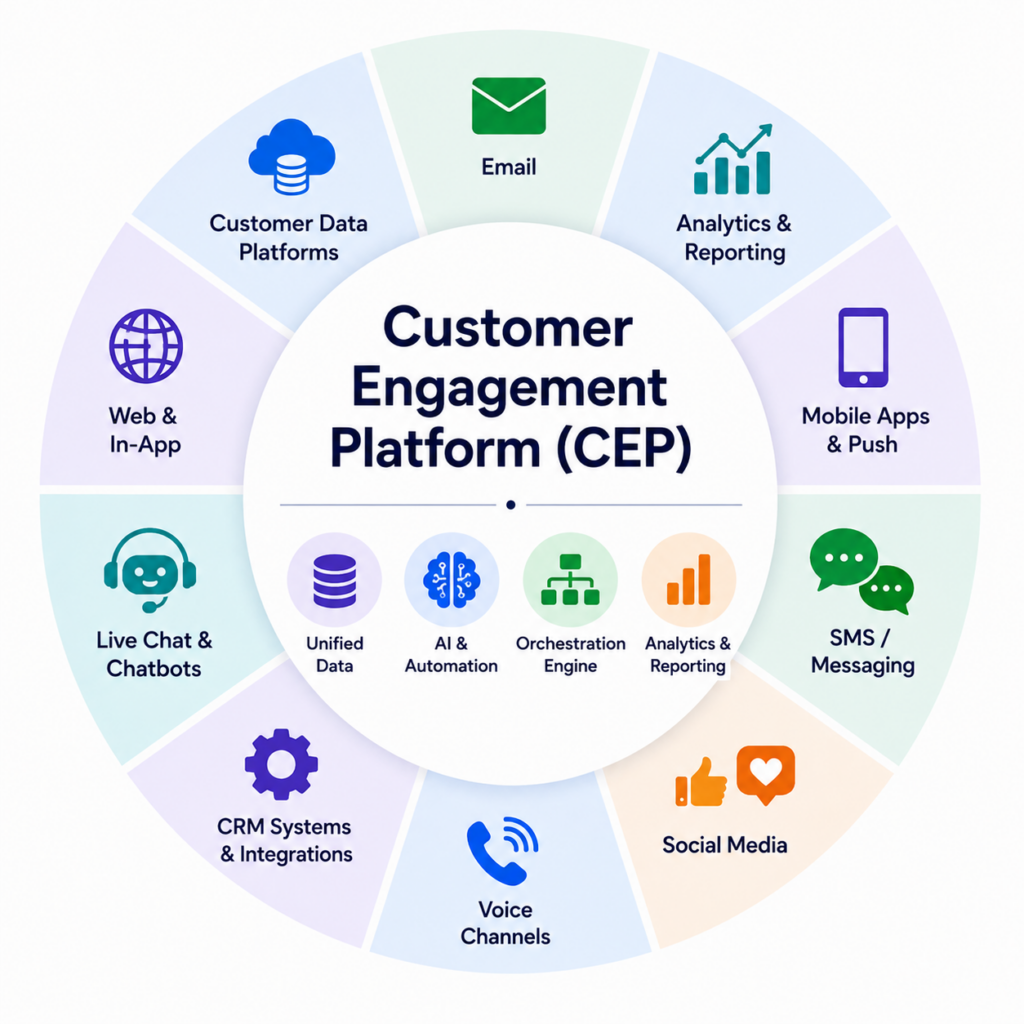
A customer engagement platform (CEP) is software that helps a business manage, coordinate, and personalize customer interactions across multiple channels from one place. Most customer engagement platforms combine channel delivery, such as voice, SMS, email, push, and in-app messaging, with audience data, orchestration, AI, and analytics. The best CEP for your business depends on the job: communications-led platforms like RingCentral unify voice and text for support teams, while marketing-led platforms like Braze orchestrate cross-channel campaigns.
5 Things to know about customer engagement platforms
- A customer engagement platform differs from a CRM because a CRM stores customer records while a CEP acts on those records to deliver messages and conversations.
- The features that matter most in a customer engagement platform are channel breadth, real-time orchestration, personalization, integrations, AI, and analytics.
- RingCentral Customer Engagement Bundle is a CEP that unifies business voice and SMS with call-queue tools, live reporting, and a 24/7 AI Receptionist.
- Other examples of CEP platforms include Braze, Salesforce Marketing Cloud, Twilio, Iterable, and Zendesk, each built for a different primary use case.
What does a customer engagement platform do?
A customer engagement platform is a software system that lets an organization manage, orchestrate, and optimize personalized customer interactions across communication channels. A customer engagement platform connects customer data to message delivery so a business can reach the right person, on the right channel, at the right time.
- A customer engagement platform centralizes channels so a business can manage voice, SMS, email, push, in-app, and web messages from one interface.
- A customer engagement platform uses audience data, often pulled from a CRM, CDP, or data warehouse, to decide which message to send and when.
- A customer engagement platform supports both scheduled campaigns to a defined audience and triggered messages that respond to real-time actions such as a sign-up or an inbound call.
- A customer engagement platform increasingly includes AI for send-time optimization, channel selection, automated responses, and 24/7 virtual agents.
What are the benefits of a customer engagement platform?
A business needs a customer engagement platform when customer conversations are spread across disconnected tools and messages get missed, delayed, or duplicated. Consolidating engagement into one platform reduces lost interactions and gives teams a single, consistent view of every customer.
- A customer engagement platform reduces missed messages because all channels feed into one shared workspace instead of separate inboxes and apps.
- A customer engagement platform improves response speed because teams act on customer signals in real time rather than from outdated lists or batch schedules.
- A customer engagement platform supports consistency because a customer receives coordinated messaging across channels instead of conflicting or repeated outreach.
- A customer engagement platform raises efficiency because automation and AI handle routine questions, freeing staff for complex issues.
What features should you look for in a customer engagement platform?
The most important features to look for in a customer engagement platform are channel breadth, real-time orchestration, personalization, integrations, AI, and analytics. A buyer should weigh each feature against the platform’s primary use case, whether that is customer support, marketing, or programmable communications.
- Channel breadth means a customer engagement platform natively supports the channels your audience uses, which may include voice, SMS, email, push, in-app, web, and WhatsApp.
- Real-time orchestration means a customer engagement platform can trigger and adapt messages or call routing based on live customer behavior, not only fixed schedules.
- Personalization means a customer engagement platform inserts customer-specific content, such as names, order history, and contextual offers, into each interaction.
- Integrations mean a customer engagement platform connects cleanly to your CRM, CDP, or data warehouse so customer data flows without heavy engineering.
- AI capabilities mean a customer engagement platform can automate responses, optimize timing, and run virtual agents, and a buyer should confirm whether these are native or add-ons.
- Analytics means a customer engagement platform reports on delivery, engagement, conversion, and revenue, ideally with built-in A/B or multivariate testing.
How is a customer engagement platform different from a CRM, CDP, or marketing automation?
A customer engagement platform is built to act on customer data and deliver interactions, which separates it from a CRM that stores records, a CDP that unifies data, and marketing automation that runs scheduled campaigns. These tools often sit side by side in the same stack and complement one another.
- A CRM is built to manage customer and account records and relationship workflows, while a customer engagement platform is built to coordinate and deliver interactions across channels.
- A CDP is built to ingest data from all sources, resolve identities, and build unified profiles, while a customer engagement platform consumes those profiles to execute messaging.
- A marketing automation platform is built for scheduled, rule-based campaigns tied to a sales funnel, while a customer engagement platform is built to respond to behavior in real time across more channels.
Bottom line: a CRM and a CDP organize what you know about customers, marketing automation runs planned campaigns, and a customer engagement platform turns that data into live, cross-channel conversations.
What are examples of CEP platforms?
Examples of customer engagement platforms include RingCentral, Braze, Salesforce Marketing Cloud, Twilio, Iterable, and Zendesk. Each platform below is built around a different primary use case, so the best fit depends on whether a business leads with support communications, marketing orchestration, or developer-built workflows.
RingCentral Customer Engagement Bundle
RingCentral Customer Engagement Bundle is a communications-led customer engagement platform that unifies business voice and SMS with call-queue management, live reporting, and AI.
- The bundle combines three components in a single offering: the RingEX Ultra plan, the Business SMS Booster, and the Call Queues Booster, so teams aren’t left assembling separate plans or add-ons on their own.
- Voice and SMS live in one workspace. A shared inbox gives the whole team visibility into customer messages, reply templates speed up responses to routine questions, and opt-in/opt-out compliance is handled automatically.
- Call abandonment drops thanks to wait-time and queue-position announcements, along with automated callbacks that let customers hold their place in line instead of staying on hold. Supervisors, meanwhile, get live reporting on queue performance and agent activity, so they can spot problems before service levels take a hit.
- Teams can add AI Receptionist, a virtual agent available around the clock that answers and routes both calls and texts, converses in multiple languages, handles common FAQs automatically, books appointments, captures new leads, and keeps everything synced with a CRM.
- Getting started doesn’t require IT involvement. Teams can be up and running with voice and SMS support in a matter of days instead of months.
- RingCentral reports that the customer IrisVision improved agent productivity by 35% using the platform.
- Best for: SMB and mid-sized teams looking for unified voice and text support with AI built in, minus the complexity of a full contact center rollout.
Braze
Braze is a marketing-led customer engagement platform built for real-time, cross-channel messaging at consumer scale.
- Braze orchestrates messaging across email, mobile and web push, SMS, in-app messages, and WhatsApp from a single interface, using stream processing that updates customer data within seconds.
- Braze includes AI features through BrazeAI, multivariate testing, and journey orchestration for one-to-one and one-to-many campaigns.
- Limitation: Braze is purpose-built for high-volume consumer marketing messaging, which can exceed the needs and budget of small support-focused teams.
- Best for: consumer brands running high-volume, real-time marketing across mobile and web channels.
Salesforce Marketing Cloud
Salesforce Marketing Cloud is an enterprise customer engagement platform that connects cross-channel marketing to the broader Salesforce ecosystem.
- Salesforce Marketing Cloud supports email, mobile, social, and web messaging with journey orchestration and segmentation, integrated tightly with Salesforce CRM data.
- Limitation: Salesforce Marketing Cloud offers broad enterprise capability but can carry higher implementation complexity than purpose-built point solutions.
- Best for: large enterprises already standardized on Salesforce that want marketing engagement inside the same ecosystem.
Twilio
Twilio is a developer-first customer engagement platform delivered through programmable communications APIs.
- Twilio provides APIs for SMS, voice, email, and WhatsApp that teams embed into their own applications, plus Twilio Engage and Segment for customer data and campaigns.
- Limitation: Twilio is API-centric and typically requires developer resources to build and maintain engagement experiences.
- Best for: companies with engineering teams that want to build custom, programmable communication workflows.
Iterable
Iterable is a cross-channel customer engagement platform aimed at consumer lifecycle marketing.
- Iterable orchestrates email, SMS, push, in-app, and web messaging within visual journey workflows, with segmentation, personalization, and experimentation.
- Limitation: Iterable centers on marketing engagement and does not provide business telephony or live call-queue management.
- Best for: B2C marketing teams that want flexible cross-channel campaign orchestration.
Zendesk
Zendesk is a service-led customer engagement platform centered on customer support across channels.
- Zendesk unifies support conversations across messaging, live chat, email, voice, and a help center in one agent workspace, with AI agents and a Copilot assistant to speed resolution.
- Limitation: Zendesk is oriented toward customer service and support rather than outbound marketing campaign orchestration.
- Best for: teams whose primary engagement need is multichannel customer support and ticketing.
Use-case verdicts: which customer engagement platform fits best
Best for unified voice and SMS support
RingCentral Customer Engagement Bundle fits SMBs and mid-sized teams that need voice and text support unified with queue tools, live reporting, and a 24/7 AI Receptionist.
Best for high-volume consumer marketing
Braze fits consumer brands sending real-time, high-volume marketing across mobile, web, email, and SMS.
Best for Salesforce-centric enterprises
Salesforce Marketing Cloud fits large enterprises that want marketing engagement built into their existing Salesforce stack.
Best for developer-built communications
Twilio fits companies with engineering resources that want to build custom, API-driven engagement workflows.
Best for B2C lifecycle marketing
Iterable fits B2C marketing teams that want flexible cross-channel campaign orchestration.
Best for multichannel customer support
Zendesk fits teams whose core need is service and support across messaging, chat, email, and voice.
Frequently asked questions
What is the difference between a customer engagement platform and a CRM?
The difference between a customer engagement platform and a CRM is that a CRM stores customer and account records, while a customer engagement platform acts on that data to deliver messages and conversations. A CRM answers who a customer is and what has happened with them, and a customer engagement platform decides what to send a customer now and through which channel. Many businesses use both together, with the CRM as the record system and the CEP as the engagement layer.
How much does a customer engagement platform cost?
The cost of a customer engagement platform varies by vendor and pricing model, with some charging by messages sent or monthly active users and others by users or features. RingCentral, for example, offers the Business SMS Booster at $25 and the Call Queues Booster at $35 as add-ons to a RingEX package, while pricing for the full Customer Engagement Bundle requires contacting RingCentral sales. Buyers should also weigh implementation effort and time-to-value alongside the license price.
Does a customer engagement platform use AI?
Most modern customer engagement platforms use AI for automated responses, send-time optimization, channel selection, and virtual agents. RingCentral Customer Engagement Bundle, for example, offers an AI Receptionist as an add-on, empowering businesses to answer and route calls and texts 24/7, automate FAQs, and book appointments without adding staff, so customers get instant support any time they reach out.Buyers should confirm whether a platform’s AI features are included natively or sold as separate add-ons.
Maximize service with a customer engagement platform
A customer engagement platform turns scattered customer data and disconnected channels into coordinated, personalized conversations. Support-led teams that want unified voice and SMS with built-in AI are well served by RingCentral Customer Engagement Bundle. High-volume consumer marketers tend to choose Braze or Iterable. Salesforce-centric enterprises often use Salesforce Marketing Cloud. Developer-driven teams typically build on Twilio. And support-first organizations generally rely on Zendesk. The right choice is the platform whose primary use case matches how your business actually engages customers.