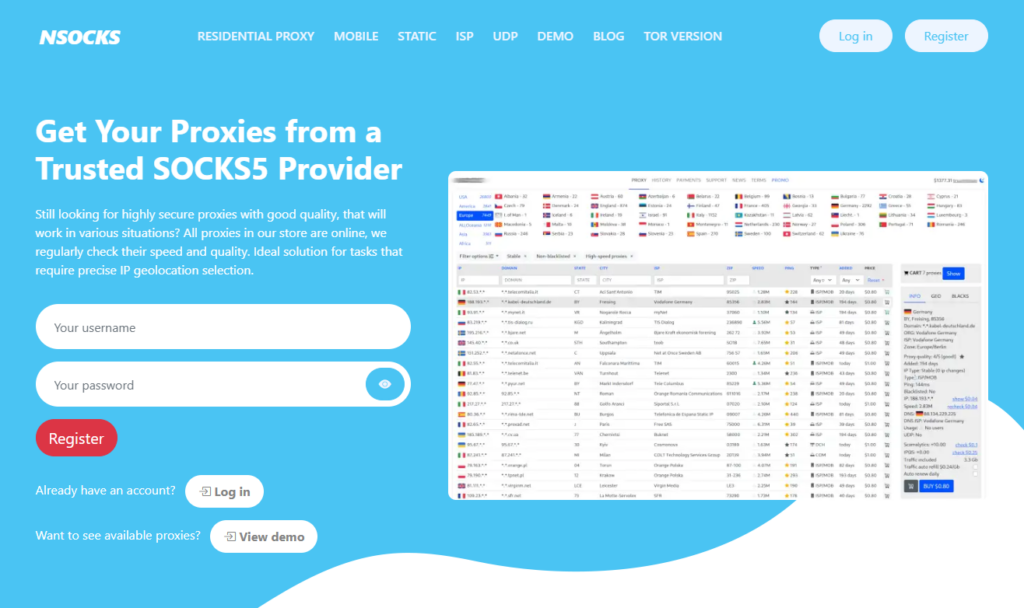
A proxy platform becomes more useful when it helps users grow in measured steps instead of pushing oversized commitments from the start. On the homepage, NSOCKS presents a model built around live stock, visible IP details, pay as you go pricing, and dashboard control. That structure suits people who want to start with one route, validate it, and add more only when the workflow proves itself. It turns scaling into a controlled process rather than a blind purchase.
Why staged scaling works better than instant expansion
Fast expansion can look efficient, but it often hides waste. When users buy too many routes before testing the first one, they carry the risk of weak geography, wrong protocol fit, and unnecessary rental time. The homepage supports a different rhythm by showing current availability, visible metrics, and no required subscription, which makes smaller first steps easier to defend.
Before any team scales, it needs proof that the first route deserves to be repeated. The homepage helps create that proof because each visible IP can be reviewed with location, ISP, speed, and protocol information before payment. A first purchase can therefore act as a benchmark for future growth instead of being just another transaction.
The table below shows how staged growth differs from rushed expansion in the homepage model. It matters because the service is based on current stock and pay as you go access rather than one package size for every buyer. A user can therefore scale with more evidence and less guesswork.
|
Scaling style |
First move |
Main risk |
Strongest advantage |
|
Staged growth |
Test one route first |
Slower spread |
Better fit before expansion |
|
Bulk expansion |
Buy many routes at once |
Higher waste |
Faster initial coverage |
|
Subscription growth |
Commit early |
Paying before proof |
Predictable billing |
|
Live stock growth |
Add from current list |
Needs active review |
Expansion based on real options |
Small beginnings create stronger evidence
A single route says more than a broad promise because it can be judged in real work. The homepage says users buy from actual availability and can inspect details in advance, which makes the first proxy a useful test case for later decisions. A route that works well becomes the model for what should be added next.
What the homepage reveals before the next purchase
Scaling decisions are only as strong as the information behind them. The homepage presents current IPs with location, speed, protocol, and ISP details, while also highlighting custom search across type, state, city, ZIP code, provider, and domain. That creates a useful pre expansion screen where buyers can compare realistic next steps instead of guessing.
The homepage also says inventory updates constantly, with new IPs coming in and used ones cycling out. This matters because staged growth depends on being able to return later and make another decision from a live pool rather than from a stale list. A changing inventory supports better timing when the buyer treats the pool as a moving resource.
|
Visible factor |
What it tells the buyer |
Why it matters for scaling |
|
Geolocation |
Where the route sits |
Guides the next regional step |
|
Speed |
How the route behaves now |
Shows whether the model is worth copying |
|
Protocol data |
Which tools can use it |
Prevents scaling the wrong setup |
|
ISP information |
Network identity |
Supports more precise matching |
|
Real time status |
Whether the route is online now |
Helps time new purchases |
|
Type filter |
LTE Residential Datacenter choice |
Guides category expansion |
Live visibility improves the second purchase
A service is easier to scale when the buyer can see the next options as clearly as the first one. The homepage emphasizes transparency in the dashboard, which means expansion can happen with the same level of review used at the beginning. That keeps later purchases from becoming more careless than earlier ones.
Step by step guide for scaling from one route to several
A good scaling method does not need to be complicated, but it does need a clear order. The homepage already provides the basics through registration, deposit, filtering, purchase, purchased proxies, renewal, and support. Those pieces can be used to build a gradual expansion routine that keeps quality ahead of quantity.
Step one prove the first route
The first step is to buy one route that matches a clearly defined task. The homepage makes this practical through visible metrics and pay as you go pricing, which means the first purchase can be treated as a working trial rather than a gamble. If that route does not prove itself, scaling should stop there.
Step two record what made the first route useful
After activation, the user should review the purchased proxy in the account and note the features that made it successful. Those may include location, type, speed, provider, or the way the route behaved inside the real tool. Expansion becomes smarter when the winning pattern is documented instead of remembered vaguely.
Step three add only one new variable at a time
The next route should usually add one change rather than several changes at once. A buyer might keep the same type and provider but move to another city, or keep the same geography and test a second provider. This makes it easier to learn what each added route contributes.
Step four decide between renewal and replacement
The homepage says the dashboard shows renewal options if available, along with support and refund handling under stated conditions. That means staged scaling should include a choice about whether to keep a strong first route, replace a weak one, or add a second line beside it. Growth is cleanest when each active route is there for a clear reason.
Comparison between deliberate scaling and uncontrolled sprawl
A controlled buildout creates a network of useful routes. Uncontrolled sprawl creates a pile of rentals that are difficult to explain, compare, or justify. The homepage design favors the first model because it keeps visibility high before purchase and management available after purchase.
Deliberate scaling builds a repeatable system
When a team grows from a proven route, each added proxy is tied to tested logic. The homepage supports that approach through live stock, detailed dashboard information, and the ability to review active entries in purchased proxies or history. Over time, this creates a more coherent operating structure.
Uncontrolled growth weakens signal quality
A large set of routes can look impressive while actually making decision making harder. If too many proxies are added before their role is understood, later results become difficult to interpret. Even a good dashboard can become noisy when growth outruns reasoning.
Information blocks for teams scaling carefully
The strongest habits are usually short ones repeated consistently. The NSOCKS homepage already provides the tools for controlled growth, so the main challenge is using them in the same disciplined order every time. These reminders help keep scaling practical and easy to supervise.
Signals that the next route should be added
- ✅ The first route has already performed well in real work
- ✅ The next route adds clear geographic or provider value
- ✅ The dashboard still feels organized after each addition
- ✅ The task genuinely needs more than one active line
Signals that scaling should pause
- ❌ The first route has not been validated yet
- ❌ New lines are being added only because they are available
- ❌ The team cannot explain why one active route differs from another
- ❌ Renewal and replacement decisions are already becoming confusing
Why this homepage fits staged growth
The NSOCKS homepage is strongest when it is used as a controlled scaling workspace instead of a simple storefront. Live stock, custom search, low entry pricing, dashboard visibility, and post purchase tools all support gradual expansion when buyers stay disciplined. For users who want to grow proxy usage without losing control, that structure makes the homepage practical in an operational way.