A proxy platform becomes more valuable when it supports growth step by step instead of forcing every user into the same operating model from day one. For teams that need to move from first validation to larger deployment, insocks com offers a structure that combines product variety, demo access, visible proxy data, dashboard history, flexible plans, and API readiness inside one service environment. That makes the platform useful not only for buying IP access, but also for building a controlled progression from manual work to repeatable scaled workflows. The strongest practical advantage appears when a company can test, confirm, expand, and monitor inside one familiar system rather than rebuilding the process at every new stage. ✨
Why growth stages matter in proxy work
A proxy setup usually fails when the team treats a pilot, a daily routine, and a scaled operation as if they were identical. The first stage needs clarity and speed of setup, the second needs repeatable controls, and the third needs automation plus reporting. When a provider exposes different tools for those stages, growth becomes easier to manage and easier to explain internally.
INSOCKS shows this staged logic clearly enough to turn it into a working model. The homepage says accounts can be created in under two minutes, IPs become available within minutes, demo plans allow early evaluation, proxy history tracks usage, and API integration supports automated scaling and management. That combination suggests the platform is built not only for immediate use, but for operational growth over time.
|
Growth stage |
Most relevant INSOCKS feature |
Why it matters |
|
First trial |
Demo access and quick signup |
Lowers the risk of a wrong first choice |
|
Early routine |
Smart search and advanced proxy info |
Helps refine selection before daily use |
|
Stable daily work |
Proxy history and visible ratings |
Supports repeatability and review |
|
Team expansion |
Flexible billing and shared dashboard |
Makes wider adoption easier to control |
|
Automation stage |
API integration and usage monitoring |
Supports larger scale operations |
|
Long term management |
24 hour support and exportable reports |
Helps maintain continuity and oversight |
Small pilots need fast entry and clear feedback
The homepage says registration is fast, dashboard access is immediate, and demo proxies can be used to evaluate speed, IP quality, rotation behavior, and authentication compatibility. That matters because a pilot should answer questions quickly instead of delaying them behind complicated setup. A good early stage reduces risk by making the first result visible before the budget grows.
Daily routines need stronger visibility than pilots
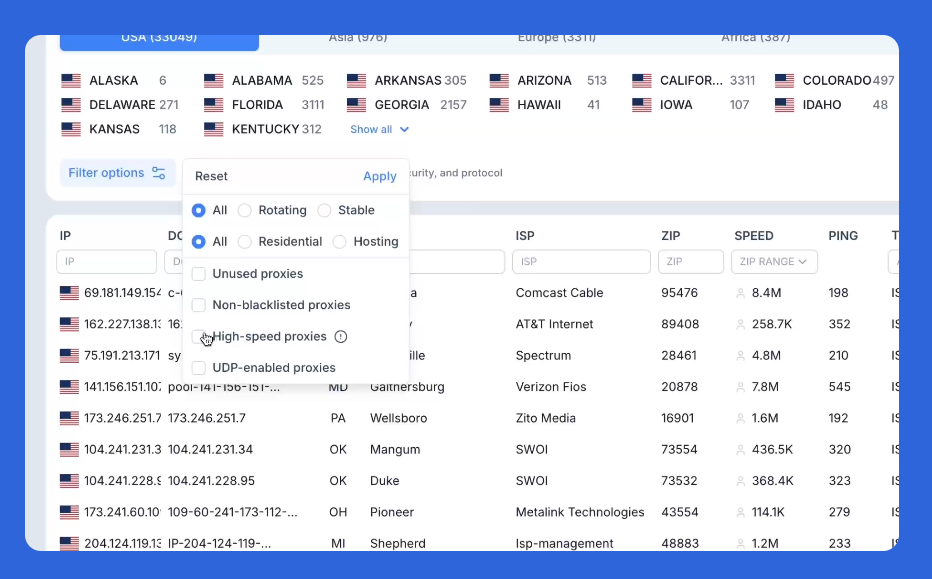
Once a proxy is used more than once, a team usually needs more than a simple login screen. INSOCKS highlights smart search, advanced proxy info, proxy rating, and history, which are all more useful in repeat work than in one time testing. These features help a team compare choices, remember what worked, and avoid turning the dashboard into a place of random purchases. ✅
Scaled operations need automation with oversight
The homepage also emphasizes API integration, usage monitoring, flexible plans, and exportable reporting. Those features matter when a workflow becomes large enough that manual handling is no longer practical, but oversight still matters. A service becomes more useful at scale when automation and review stay connected instead of moving into separate tools.
How the product range supports staged growth
A growth model is easier to maintain when product categories already map to different project needs. INSOCKS does this by separating residential, mobile, static, ISP, and UDP proxies and by linking each category to direct business tasks. That lets teams grow not only in size, but also in route sophistication as their workload changes.
This matters because a team often begins with one kind of task and later expands into others. Search monitoring can turn into price checks, account work, ad verification, or live traffic support. A platform that already includes several route families gives the company room to grow without starting over with a new supplier. ✨
Residential routes work well in discovery stages
The homepage describes residential proxies as household ISP addresses suited to web scraping, SEO tracking, price monitoring, and content verification across 195 countries. That makes them a practical early choice for teams learning how local visibility and research tasks behave. They often serve as the first serious route when the company needs trustworthy geo targeted views of the web.
Static and ISP routes support more controlled repeat use
Static proxies are described as dedicated addresses that do not change and are intended for account management, payment processing, API access, and IP whitelisted systems. ISP proxies are described as combining fast speeds with ISP legitimacy for time sensitive operations. Together, these categories help a team move from early testing into stronger repeatability and better throughput when the workflow becomes more structured. ✅
Mobile and UDP routes expand the platform into specialized work
The homepage presents mobile proxies for social media automation and ad verification, and UDP proxies for VoIP, gaming, conferencing, and live streaming. These categories usually enter the picture after the team understands its core workflow and starts handling stricter or more specialized traffic. Their presence matters because growth is not always only about volume, but also about better route fit for more demanding tasks.
Comparison between early stage and mature proxy use
The same proxy platform can feel completely different depending on whether it is being used by one person for testing or by a team running daily operations. That is why comparison by growth stage is more useful here than comparison by raw specs alone. INSOCKS is easier to understand when its features are viewed as answers to different maturity levels of work.
|
Work mode |
What the team needs most |
INSOCKS value at that stage |
|
Exploratory test |
Speed of setup and low risk |
Demo access and fast activation |
|
Repeat manual work |
Better filtering and clearer route choices |
Smart search and advanced proxy data |
|
Shared team usage |
Visibility across several people |
History and common dashboard controls |
|
Department level workflow |
Flexible billing and product variation |
Multiple plans and five proxy categories |
|
Automated operations |
Scalable management and monitoring |
API support and usage tracking |
|
Mature long term use |
Stability and responsive help |
24 hour support and reporting tools |
Early stage work is about confidence not maximum scale
The homepage makes early adoption easier by offering a small entry path through demo plans and rapid onboarding. That matters because most teams do not need large scale automation in their first hour with a new provider. They need enough confidence to prove that the route category, authentication, and task match are correct before moving further. ✅
Mature use is about control not just access
Later, the emphasis changes. History, exportable usage reports, flexible plans, API readiness, and support channels become more important because the workflow now affects budgets, internal coordination, and long term reliability. A mature proxy process therefore depends on control features as much as on the IPs themselves.
One platform can support both if the team stays deliberate
A common mistake is assuming that early route choices should remain unchanged forever. The product range and support structure on the homepage suggest the opposite: teams are expected to evolve, test new fits, and expand responsibly. A good platform supports that evolution without forcing a full reset every time the work becomes more complex. ✨
Step by step guide for growing inside one platform
A controlled growth path usually works better than an improvised one. The structure below follows the logic visible on the homepage and turns it into a simple routine. This helps the team move from first trial to stable expansion without treating every stage as a separate project.
Step one start with the real task not the full catalog
Begin by deciding whether the workflow is closer to search monitoring, content verification, account management, social activity, high speed scraping, or real time traffic. The homepage already maps these workloads to the main proxy families, which means the first decision should be task based rather than price based. A better fit at the start usually saves more time than a cheaper but weaker route choice. ✅
Step two use a demo before approving wider usage
INSOCKS says demo plans allow users to test speed, IP quality, rotation behavior, and authentication compatibility. This should be the normal bridge between interest and deployment. A team that validates through a demo is less likely to scale the wrong product into daily work.
Step three keep daily learning inside the dashboard
Once the workflow becomes regular, use the visible route data, ratings, and history to refine choices instead of repeating the same guesswork. The homepage specifically highlights proxy history and advanced proxy info, which means the dashboard is meant to support learning after purchase as well as before it. Repeated work improves faster when earlier results remain visible. ✨
Step four add automation only after the manual process is clear
The homepage offers full API integration for scaling and management, but automation is most useful after the team already understands how the routes behave manually. This keeps mistakes small before they become system wide. A stronger workflow usually grows from understanding first and automation second. ✅
Informational block for practical team use
The homepage also supports growth through the less obvious parts of the service. It highlights 24 hour support, flexible billing, a minimum purchase entry point, no long term contracts, and a no logs policy message tied to privacy by design. These details matter because a growing team does not only need working routes, it also needs a service model that is easier to approve, manage, and trust over time.
Recommended practices
- ✅ Begin with the proxy family that matches the actual business task.
- ✅ Keep demo use as a standard first stage before larger rollout.
- ✅ Use history and route data to improve later decisions.
- ✅ Move to API management only after manual success is clear.
- ✅ Review billing and support fit before the workflow gets larger.
Mistakes worth avoiding
- ❌ Do not treat every proxy category as interchangeable.
- ❌ Do not skip the demo stage because activation is fast.
- ❌ Do not scale a route simply because the first login worked.
- ❌ Do not separate support and reporting from technical evaluation.
Where this growth model creates the most value
INSOCKS is strongest for teams that want to grow inside one operational environment instead of stitching together a new vendor stack at every stage. Its homepage gives enough product separation, testing support, route visibility, reporting, and automation readiness to support a controlled path from pilot to stable use. That makes the platform especially practical for organizations that expect proxy needs to evolve rather than stay fixed. ✨
The clearest value appears when a team wants to keep learning, scaling, and monitoring inside the same platform without losing visibility. Fast onboarding, demo plans, detailed route information, history, API support, flexible billing, and several proxy families all contribute to that progression. When those features are used in sequence instead of all at once, the service becomes easier to manage and much easier to grow with. ✅